
Phyllostachys edulis (Carrière) J.Houz
Synonyms: Phyllostachys heterocycla (Carrière), Phyllostachys mitis, Mitford; P. heterocycla var. pubescens (Mazel ex J. Houzeau) Ohwi; P. pubescens Mazel ex J. Houzeau.
Moso, Mōsōchiku (Japanese: モウソウチク– Moso Bamboo),Mao zhu (Chinese: 毛竹 – Hair Bamboo)

A grove of Phyllostachys edulis growing at Trebah Gardens, Cornwall, England. Photo by James Youdale.
Native to
Phyllostachys edulis is indigenous to China and considered naturalised in Japan, where it was introduced in circa 1750 to Okinawa, purportedly by the daimyō Shimazu Yoshitaka.
Overview
| Rhizome type | Monopodial Leptomorph Running * |
| Soil conditions | All |
| Hardiness | Lows of -20 (Zone 6) for mature specimens but considerably less for very small juvenile plants. |
| Habit | Upright |
| Maximum Height | Up to 30 metres recorded in favourable conditions. Stands in Cornwall reach up to 10 metres. |
| Maximum Culm Diameter | Up to 18cm recorded in favourable conditions. For the rest of the UK, considerably less is to be expected. |
| Maximum Spread | Eventually forming an open grove or small forest in favourable conditions. |
| Suitable for | Probably only a bamboo for the collectors in the UK, unless you live in the South West of the Country. Not thought to be well-suited to container culture. |
| Notes on Flowering | Last Known Flowering: Multiple clones are in existence, ensuring a regular supply of seeds Known cycle of flowering: Between 60 and 130 years |
Species Description / How to identify
- Phyllostachys edulis at Flora of China
- Phyllostachys edulis at Plants of the World Online
Commentary
A most distinguished bamboo capable of reaching towering heights and monstrous culm circumferences in growing conditions to its liking. Phyllostachys edulis is both culturally and economically important in its native country of China, as well as in Japan where it is naturalised having been introduced in the Tokugawa period circa three centuries ago.

Acer palmatum in the foreground with Phyllostachys edulis growing behind it on Mount Inari, near Kyoto. Photo by James Youdale.
Phyllostachys edulis is a timber bamboo; its large and thick-walled culms are harvested for a range of construction and crafting purposes, while its culm sheaths are utilised for the making of paper.
As the Latin name ‘edulis’ implies, the young shoots are also valued for their flavour and are cultivated widely in East Asian countries for culinary use.
While engrained into the national consciousness of Japan where the species has been grown, admired and harvested for nearly three centuries in all but the most northerly regions, vast and wandering colonies of Moso which have spread from abandoned farms have become a cause for environmental concern in recent times as they encroach upon the unspoilt habitats of indigenous plants, private land and even civil infrastructure.
Indeed, as a mature plant, Phyllostachys edulis is capable of growing in an open, forest-like fashion, spreading widely and reaching great sizes in warm climates such as parts of the United States and the South of France. Closer to home, it has even performed well in select locations in the South West of England, such as Cornwall. While witnessing Moso in settings such as Trebah Garden comes highly recommended (and is truly a sight to behold) it is unlikely to ever reach anything resembling its potential elsewhere in the United Kingdom, where our summers rarely heat the soil sufficiently and our mild autumnal conditions are relatively short-lived in contrast to places such as China and Japan, which is thought to inhibit rhizome development and thus slow its growth. Nevertheless, it is a hardy plant when mature, and is capable of surviving winters down to -20, which far exceeds all but the very coldest conditions ever recorded in the United Kingdom.
As is rarely the case for a species of bamboo, seed-grown plants and seed are regularly available due to the large number of clones of Phyllostachys edulis in cultivation. This means that while the flowering patterns for individual clones may be between 60 to 130 years they do not occur as uniformly as is the case for many species, such as has been observed more recently in clones of Phyllostachys nigra. In UK conditions these seed-grown specimens behave as tightly-clumping and large-leafed plants of little stature which struggle to – and often never do – emerge from the juvenile phase of growth. Anecdotally, one such plant grown in Northumberland in the North East of England has remained in this state for over a decade, where it is dwarfed by neighbouring stands of plants in the genus Fargesia. Indeed, in the Nikon-Chiku, it was noted as far back as 1899 that early attempts to introduce this species to England scarcely even resembled the plants growing in Japan.
Where our UK climate is most favourable to the needs of Phyllostachys edulis – such as Cornwall – and where significant space and light is available with moist and fertile soil, it is recommended to plant a specimen that is already capable of producing mature growth, otherwise, significant – potentially open-ended – patience and heavy feeding is required to coax it from its juvenile state. Whittaker (2005) notes that those spectacular stands of Moso in Cornwall took as long as 30 years to reach maturity. Happily for gardeners, however, there are alternative species of Phyllostachys which provide better results for those looking to grow large, thick caned bamboo in our climate. See:
- Phyllostachys vivax and its forms;
- Phyllostachys bambusoides and some of its forms.
- Phyllostachys parvifolia
- Phyllostachys dulcis
Cultivation and Propagation
Propagate by division or taking rhizome cuttings, preferably in the spring. Due to an unusual situation where clones of Phyllostachys edulis have asynchronous flowering patterns, a regular supply of seed is usually available from China. Seed viability is usually quite poor – out of a hundred seeds, perhaps two or three may sprout. Seedlings display varying degrees of vigour, but usually those which survive to the second year indoors or the greenhouse are suitable to introduce to the outdoors.
The Nikon-Chiku advises taking cultivations in rainy weather, or shortly before rain. Hot and dry weather should be avoided, and if attempted should be undertaken with an ample supply of water available to keep the divided plant from drying out.
To reach anything resembling its potential, heavy feeding and fertilisation is advised while watering sufficiently to avoid its soil becoming dry.
A fertile, humus-rich soil supplemented by a mound of organic material is advised for best results. While the Nikon-Chiku advises feeding heavily with both animal and human manure, the carcasses of dead animals and bin scrapings, an effective approach may be to create a mound on top of the clump filled with nitrogen, silicone and phosphorous rich elements such as grass and garden clippings, farmland manure, small amounts of wood ash, bamboo leaves and culm sheaths, or shredded bamboo canes.
Other forms
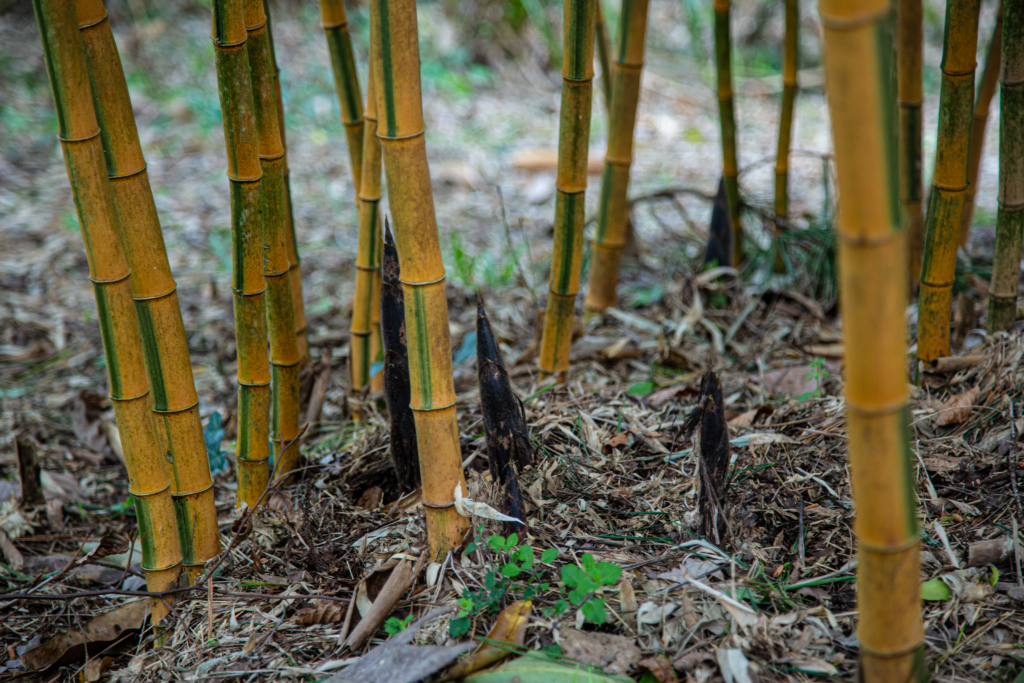
Phyllostachys edulis ‘Bicolour‘
This form is considered to grow smaller than the type. Where conditions are to its liking it can still grow to 12 meters tall with culm diameters over 10cm. It is most notable for its culm colour of yellow with green stripes (known in Japanese as ‘kimmei’). Anecdotally, it is even less suited to outdoor UK growing conditions than the type, and as such is exceptionally rare in UK cultivation.
In 2001, a group including Mike Bell imported 10 specimens of P. edulis ‘Bicolour‘ to the United Kingdom at a significant cost, and of those ten, only one survived. As of 2026, there may be as few as 6 plants growing across the entire country.
Phyllostachys edulis ‘Heterocycla’ (syn: Tortoiseshell Bamboo)
This form grows much smaller than the type and is notable for its protruding and bulbous culm internodes, as well as its textured growth habit. It is rarely in cultivation in the West and sadly specimens in the U.K., such as that at Hilliers Arboretum, have not as yet produced its strikingly ornamental culm forms.
Phyllostachys edulis ‘Bokrijk’
A selected hardier form from the only seed raised plant to survive a succession of exceptionally cold winters in the early 2010s at Bokrijk Arboretum in Belgium. It has demonstrated its hardiness in the U.K. but time is required to see how it compares in terms of stature.