
Phyllostachys bambusoides (Siebold & Zucc)
Synonyms: Madake, Phyllostachys quilioi, Phyllostachys reticulata, ‘Giant Timber Bamboo’
Author: James Youdale
Last edited: November 10th, 2026
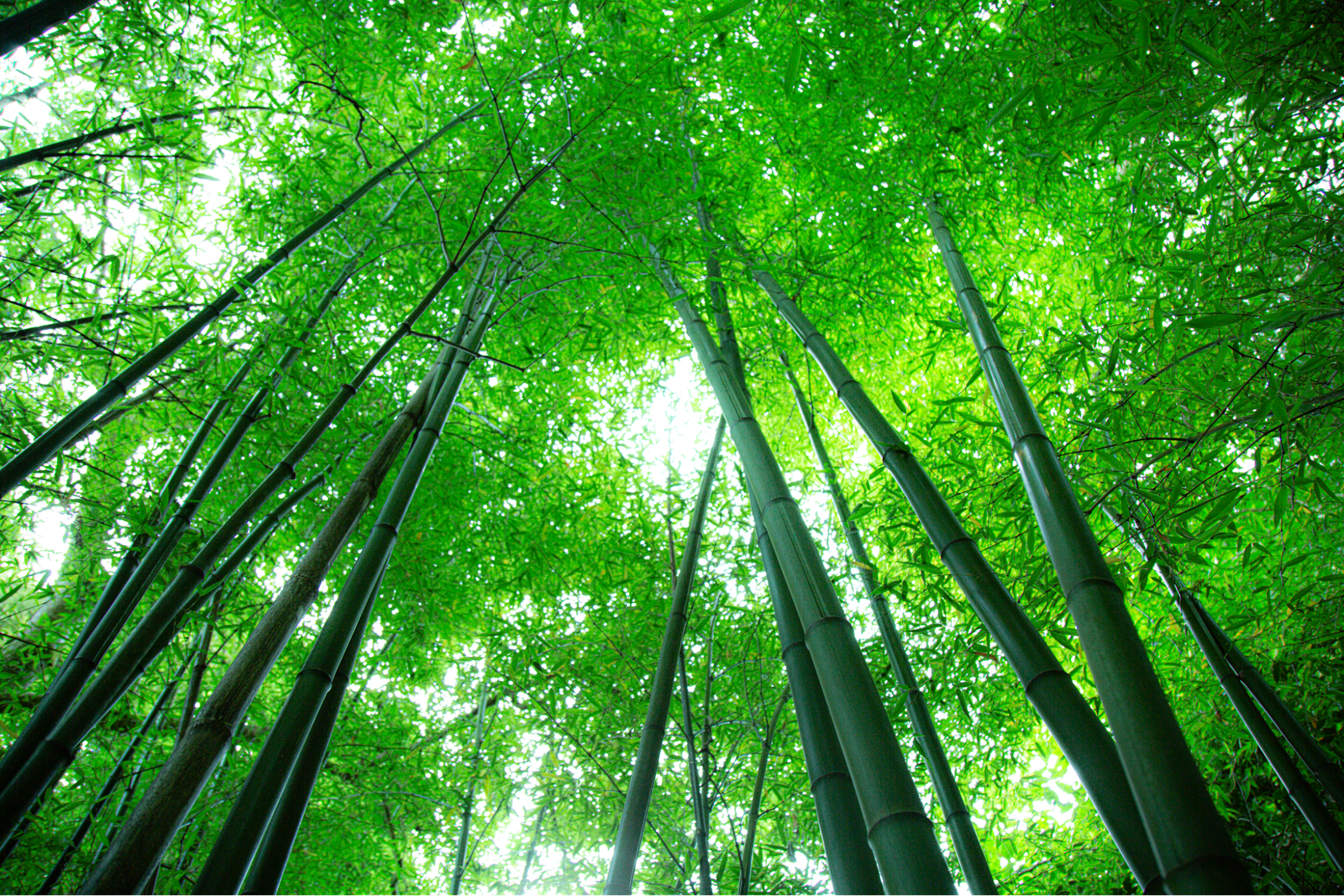
Phyllostachys bambusoides growing in Penjerrick Garden, Cornwall. This is probably the finest example of the rarely-grown type species in the United Kingdom. Photograph by James Youdale.
Native to
Phyllostachys is a genus of running bamboos native to China and naturalised in Japan and Korea.
Overview
| Rhizome type | Leptomorph; monopodial; running |
| Soil conditions | All. In dry soils, additional watering may be required during the summer months. |
| Hardiness | Down to -18 celsius (Whittaker, 2005) has been recorded by UK growers, but -20 has also been quoted in continental Europe (Vaupal, 2005). |
| Habit | Upright |
| Maximum Height | The type species has been said to reach up to 24 meters in its native habitat (Vaupal, 2005), but is considered to generally reach a maximum of 8 meters in UK conditions (Whittaker, 2005).
14 meters has, however, been recorded in Cornwall (ibid, 2005) |
| Maximum Culm Diameter | As much as 15cm (Whittaker, 2005) to 16cm (Vaupal, 2005) in native growing conditions. |
| Maximum Spread | Siting and growing conditions play a role, but it is generally considered to be ‘well behaved’ in UK growing conditions, eventually producing an open grove of between 1 and 4 meters (Whittaker, 2005). |
| Suitable for |
There is some suggestion (Wilson, 2025) that this species and its cultivars do not prosper in container culture, and may be even more susceptible in such conditions to disease and aphid attack. |
| Notes on Flowering | Last Known Flowering: A flowering of Phyllostachys bambusoides was observed circa 1899 in Japan (Katayama, 1899).
The last widespread flowering was between 1963 and 1978, with reports of many stands recovering (Vaupal, 2005). More recently, at least one clone of Phyllostachys bambusoides ‘castillonis’ in the UK flowered between 2017 and 2023 (Wilson, 2025). Known cycle of flowering: It is believed to be between 60 and 120 years (ibid, 2005), however the last two flowering events of certain cultivars (e.g. Castillonis) were between 60 and 70 years apart, suggesting that another flowering event may be due in the next few years. The aforementioned recent flowerings of some clones of bambusoides ‘Castillonis’ perhaps represent an early sign of this. |
Species Description / How to identify
Commentary
Instantly recognisable – iconic, one could say – and a Phyllostachys with some of the most ornamental and interesting forms available. Even going back to the earliest days of bamboo cultivation in the UK over 125 years ago, the various cultivars of Phyllostachys bambusoides evoked awe… and some confusion.
“Indeed, Phyllostachys bambusoides presented itself to me in so many shapes, that I began to look upon it as the Mrs. Harris of Bamboos, and became as sceptical as to its existence as Betsy Prig” – Mitford, 1899, p57
Phyllostachys bambusoides is native to China and has since become naturalised in Japan, where it is known as ‘madake’ – a giant timber bamboo that produces strong, woody canes that lend themselves well to construction and crafts. Famously, this includes the creation of the shakuhachi flute. Whereas Phyllostachys edulis is cultivated for both its timber and for human consumption, the shoots of Phyllostachys bambusoides are said to be less palatable (Vaupal, 2005).
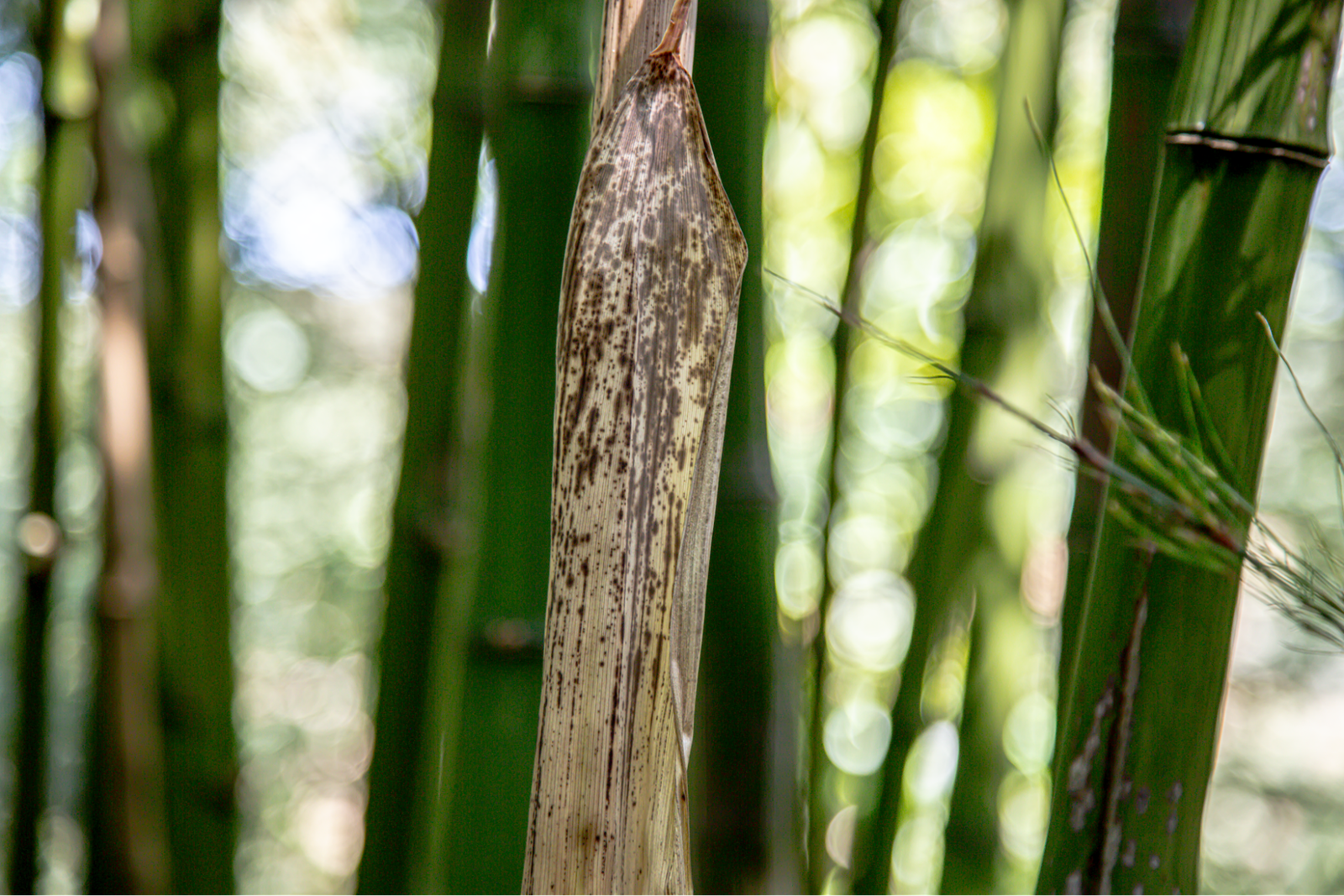 The sheath coming away from a new culm on Phyllostachys bambusoides ‘Marliacea’. Photograph taken by James Youdale in John Bailey’s ‘Wheal Jenny’ garden. The culm sheath displays the mottled pattern typical of this species.
Phyllostachys bambusoides is thought to have first been introduced into western cultivation in 1866 by Du Quilio (Crampton, 2006) hence the antiquated name for this species of ‘Phyllostachys quilioi’.
Two of the defining characteristics of this species are its strong branches – considered longer than any other species of Phyllostachys (Bell, 2003) and its long leaves. The life expectancy of a mature culm is said to be greater than other hardy bamboo species (Whittaker, 2005).
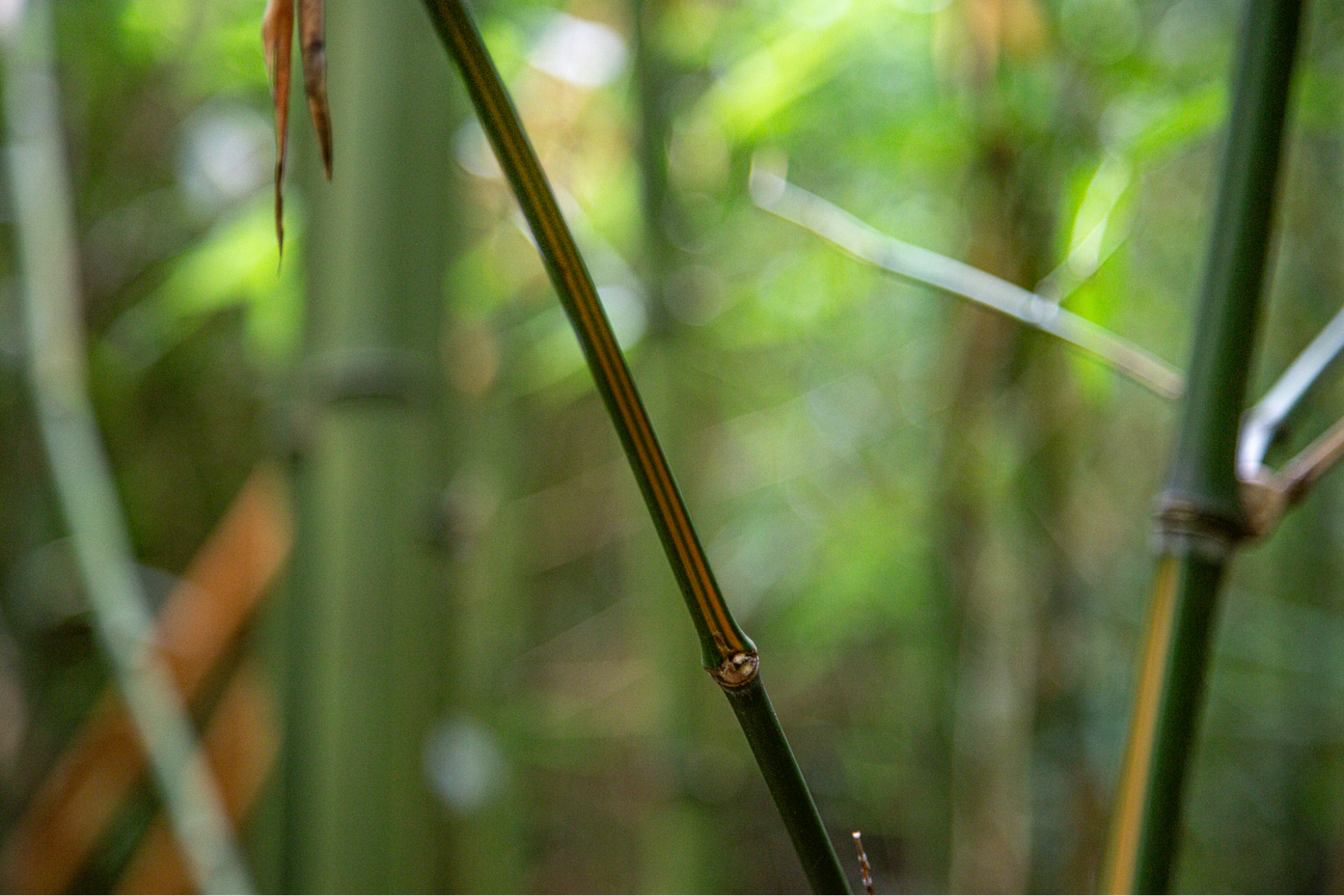 The strong branches of Phyllostachys bambusoides are considered to be a key feature that aids with identification. In this photograph, both a sulcus and the colouring present in culms can be observed in Phyllostachys bambusoides ‘Castillonis inversa’. Photograph taken by James Youdale in the collection of Mike Bell.
While Phyllostachys bambusoides and its forms are fully hardy for UK growing conditions, they rarely achieve the stature that they are capable of reaching in warmer climates (Bell, 2003). For similar reasons to the issues that growers of Phyllostachys edulis experience in the UK, the relatively cool and short summers do not provide a sufficient growing season for Phyllostachys bambusoides to thrive. The species typically produces new shoots in the spring in China and Japan (Shi et al, 2021), however the soil is usually only warm enough in July and August in UK conditions. This has the knock-on effect of allowing less time during the growing season for rhizome development given the relatively short warm autumn weather in the UK. This can create a cycle of slow and stunted growth, which is particularly prevalent for some cultivars more than others.
Unlike Phyllostachys edulis, however, good growth is possible for the patient gardener – particularly in South East and West of England. Rather than appearing in abundance, often, only a few new shoots of Phyllostachys bambusoides are to be expected each year in most UK conditions.
All forms of this species are said to be particularly prone to aphid attack (Crampton, 2006), which may be particularly prominent in containerised plants – to which this species is said to be poorly suited (Wilson, 2025). While the nuisance of aphids is unlikely to cause any significant impact to the plant, it may make foliage unsightly, or on especially small plants, inhibit photosynthesis if leaves become heavily saturated with aphid droppings (Whittaker, 2005).
Selected clones and cultivars
There are a wide variety of cultivars of Phyllostachys bambusoides and there is some degree of debate about the classification of some clones. In some literature such as Recht and Wetterwald (1992) Phyllostachys violascens is described as a cultivar of Phyllostachys bambusoides, but based on more recent literature it is treated as a distinct species within the auspices of this discussion.
Cultivars not thought to be available in the United Kingdom (e.g. Phyllostachys bambusoides ‘Geniculata’) are not included within this text.
Phyllostachys bambusoides ‘Castillonis’ (or ‘Castilonii’)
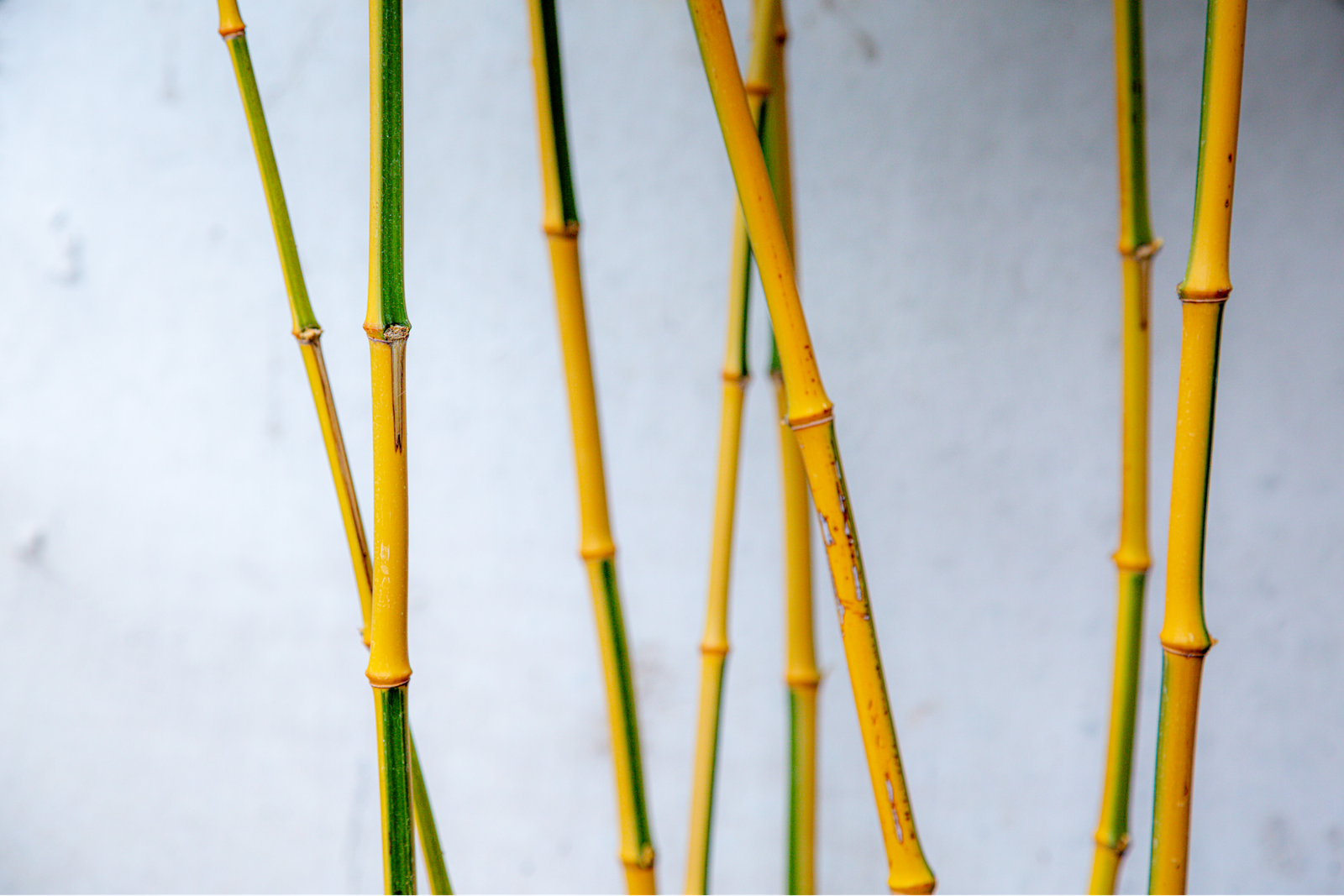
A small plant of Phyllostachys bambusoides ‘Castillonis’ growing in the author’s garden, County Durham. Photograph taken by James Youdale.
A form that is much prized for its ornamental value and known as ‘kimmei-chiku’ (gold bright bamboo) or ‘shima-dake’ (striped bamboo) in Japan. This cultivar differs from the type species by having yellow culms with a green sulcus groove, and is said to grow more vigorously than the type species – at least in United Kingdom growing conditions (Crampton, 2006).
This bamboo can be distinguished from Phyllostachys vivax ‘Aureocaulis’ – another potentially large bamboo with similar colouration – by the more stable green stripe in its sulcus, as opposed to a more random striping in ‘Aureocaulis’. It is perhaps more readily confused with Phyllostachys vivax ‘Huangwenzhu inversa’ which also possesses the stable green sulcus colouration.
At least one clone grown in the UK flowered and by available records uniformly died between 2015 and 2020 (Wilson, 2025). As such, this cultivar is less widely grown than in the recent past and finding mature specimens to photograph has been a significant challenge! One large plant that was presented to me as Castillonis was in fact the aforementioned Phyllostachys vivax ‘Aureocaulis’.
A previous flowering in the 1960s had a similar effect – although some plants did regenerate and reverted back to the green type species – leading to the form needing to be re-introduced into western cultivation from Japan. Nevertheless, as of 2026, a number of plants in the nursery trade have shown no signs of flowering. Hypothetically:
- these plants may be of a different clone (as a number may be in circulation given the long history of cultivation of this form in the United Kingdom);
- they may be due to flower imminently – having been thus-far held back from flowering due to regular splitting for nursery propagation purposes or the like;
- or… they may simply have skipped flowering in this cycle.
Time will tell.
There is another rarely-seen-in-UK-cultivation clone of this form with variegated leaves known as Phyllostachys bambusoides ‘Castillonis variegata’, however Bell (2003) reports that it is slower to grow than the parent cultivar, and in his view is a less worthy garden plant.
Phyllostachys bambusoides ‘Castillonis inversa’
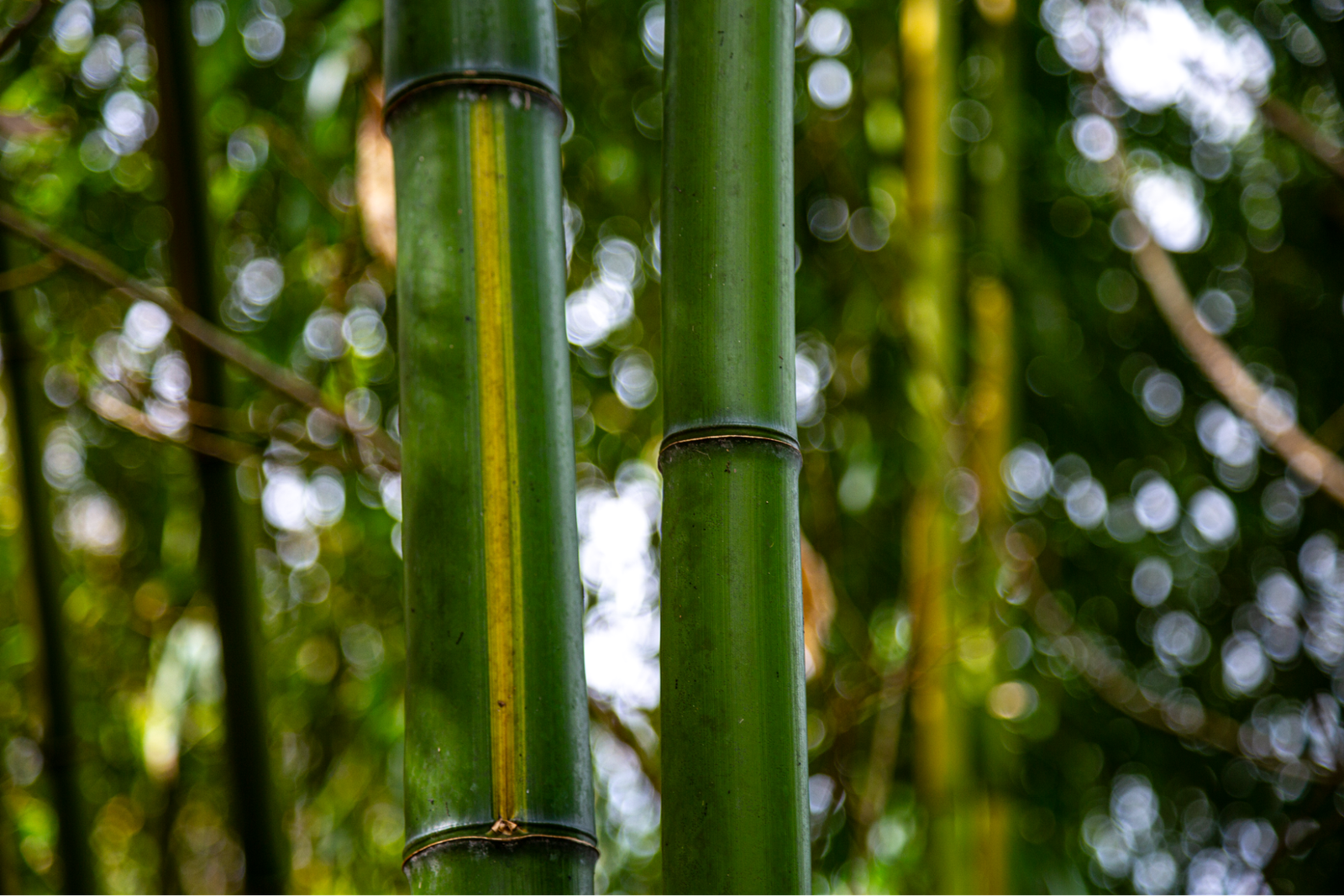 Phyllostachys bambusoides ‘Castillonis inversa’ growing in John Bailey’s Wheal Jenny garden. Photograph by James Youdale
This form has inverse culm colouration to ‘Castillonis’, in that the culm is green and the sulcus is yellow. It appears to have emerged from a separate clone to ‘Castillonis’, as there have been no reports of this cultivar flowering in recent years (Wilson, 2025).
“There is also a variety [of Phyllostachys bambusoides] in which the colours are reversed, that is the groove is yellow, while the rest of the internode is green […] This should be called 碧玉間黄金竹 (Heki- gioku-kan ō-gon-chiku) [Golden bamboo amidst green jade-like bamboo]” – Katayama, 1899. p89.
Crampton (2006, p191) regards this as being ‘by far the best Phyllostachys with this particular colouration’ but reports it as growing to a slightly lesser stature than the yellow Castillonis form.
In appearance it is very similar to Phyllostachys vivax ‘Huangwenzhu’ and can be visually distinguished by its stronger branches, larger leaves and slightly darker green culm colouration.
Phyllostachys bambusoides ‘Holochrysa’ / ‘All gold’
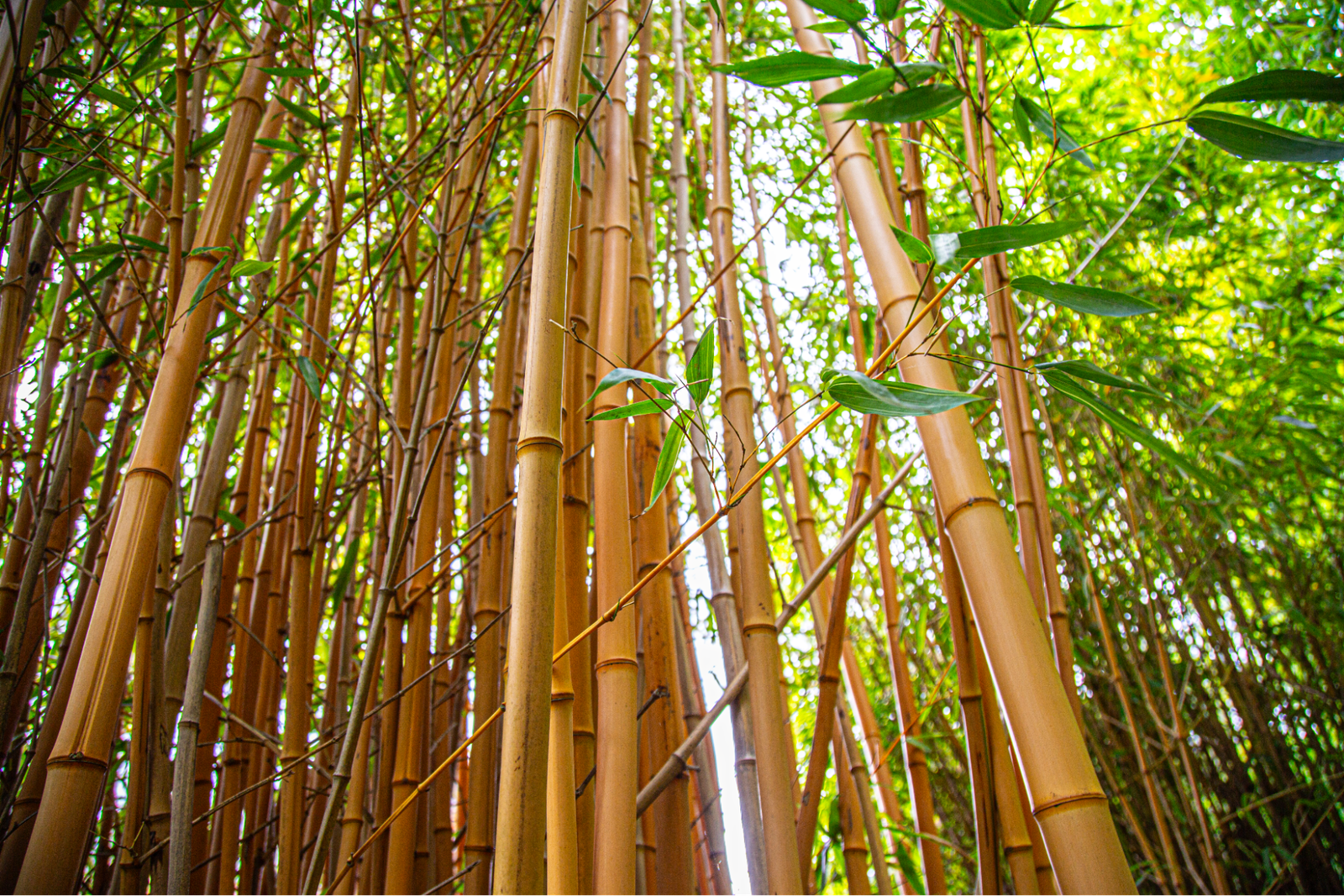 Phyllostachys bambusoides ‘Holochrysa’ photographed by James Youdale in the collection of Peter Markham, Norfolk.
This form differs from the type species by having rich yellow culms with occasionally the finest and faintest green stripe. Some degree of variegation is commonly observed on foliage. It is considered to not be capable of reaching the stature of the type species, but that is hardly relevant in our climate.
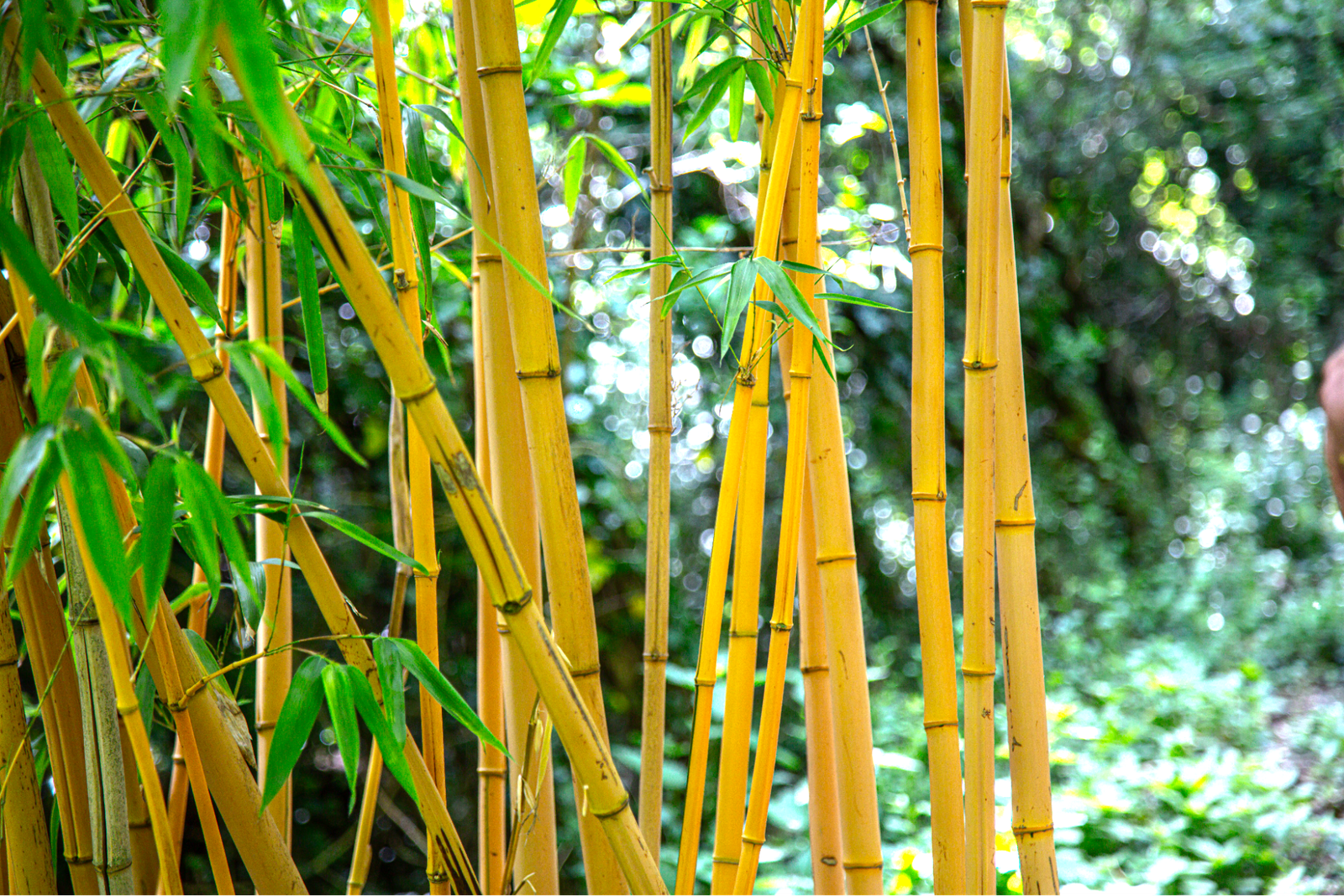 Phyllostachys bambusoides ‘Holochrysa’ growing in the collection of Greville Worthington, North Yorkshire
Some accounts suggest that this form emerged from a stand of ‘Castillonis’ in the United States (Bell, 2003). Earlier descriptions of an ‘ogon chiku’ (golden bamboo) in Japan are made in the Nihon chiku‑fu in 1899, with later accounts suggesting that this original form was imported into the United States from Japan in the mid 1980s and then into Europe in the early 90s (Vaupal, 2005c).
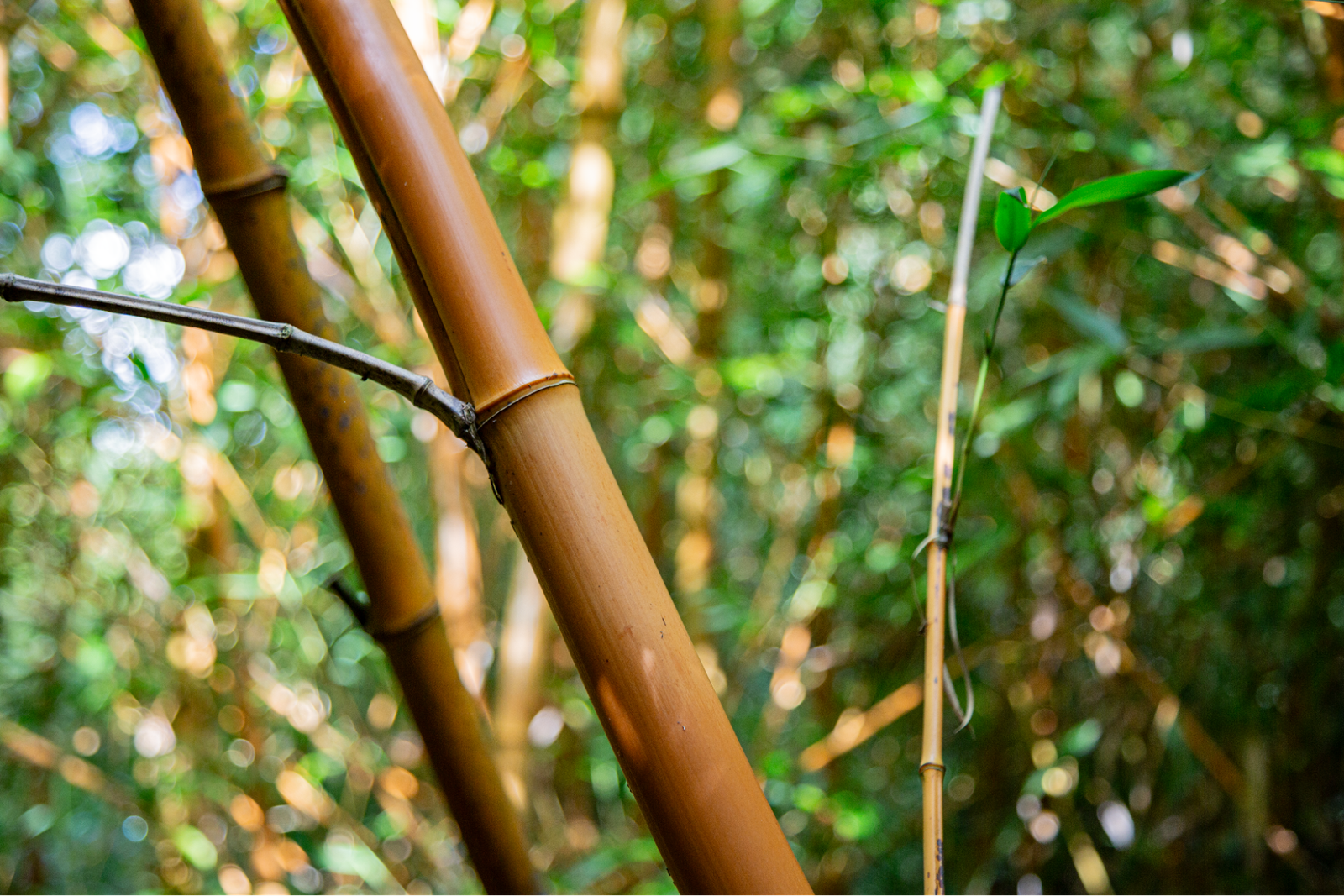 Phyllostachys bambusoides ‘Holochrysa’ photographed by James Youdale in the collection of Mike Bell, Cornwall. The strong side branching which is emblematic of bambusoides is demonstrated in this photo.
As with other forms of bambusoides it is considered to need soil warmth (ibid, 2005c) and thus is a reluctant and slow grower in many parts of the UK. For instance, two plants growing at Durham University Botanic Gardens for 20 years have remained small, and at best produce one new culm each year. On the contrary, 30 miles south in Catterick, North Yorkshire, a far larger clump has become established in shaded woodland near a small stream.
Phyllostachys bambusoides ‘Alboveriegata’
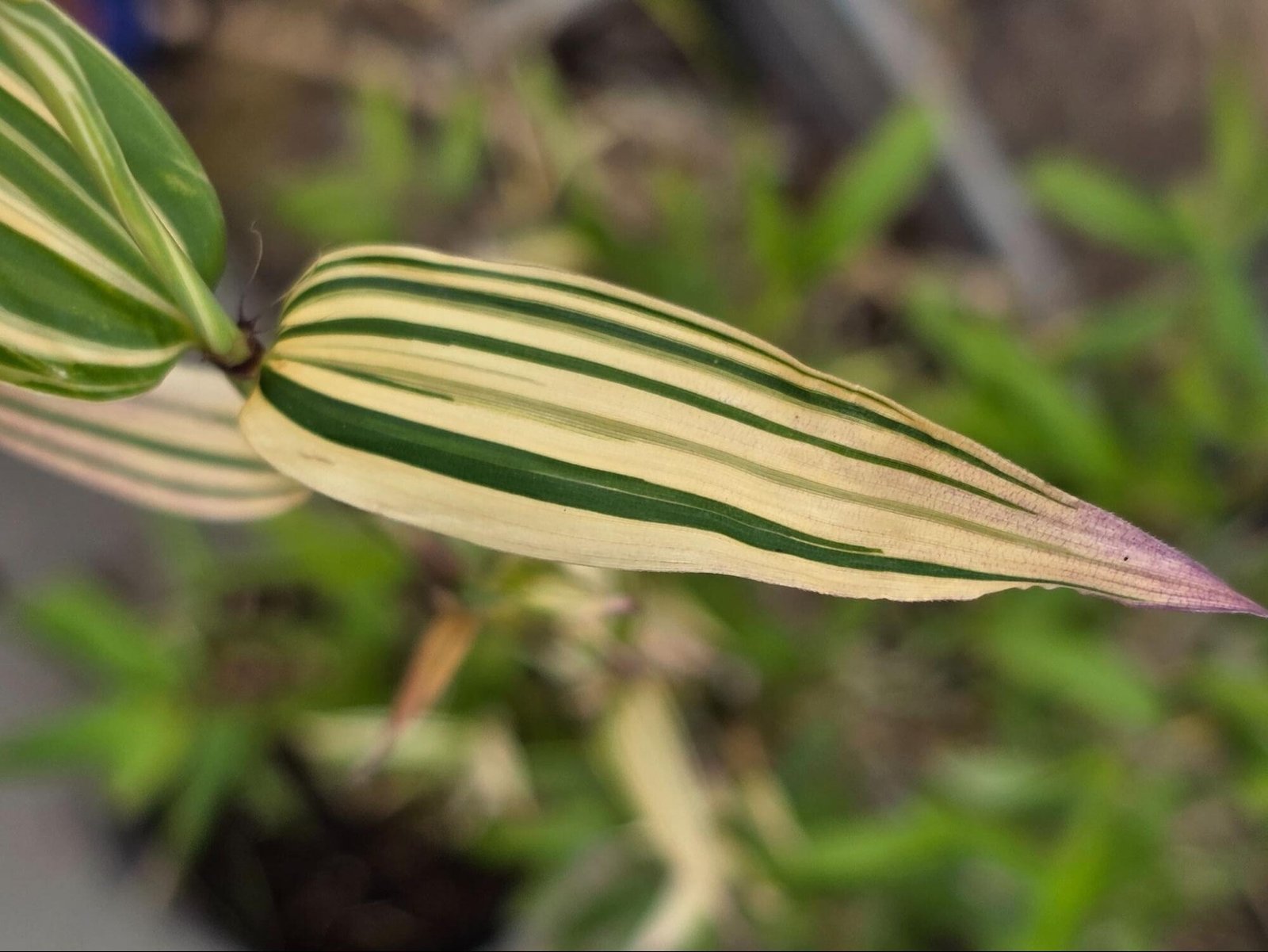 A new leaf on Phyllostachys bambusoides ‘Alboveriegata’ taken in the author’s garden, County Durham.
This form is said to have been introduced into cultivation by Jos Van der Palen (n.d a) in the Netherlands and is considered to grow smaller than the type species. New leaves emerge white with purple tips before fading to a more subtle striped variegation. With exposure to sun the leaves revert to full green colour, making a shaded planting position preferable.
As with the other forms of Phyllostachys bambusoides, outside of the South of England it rarely reaches the great heights that it is capable of, but in many senses, that’s just as well for this particular cultivar. To enjoy each new flush of variegated foliage, having a small plant isn’t the worst thing in the world – as Mike Bell put it to the author with regards to the towering plant in his own garden: “the only snag is that the foliage is up in the clouds.”
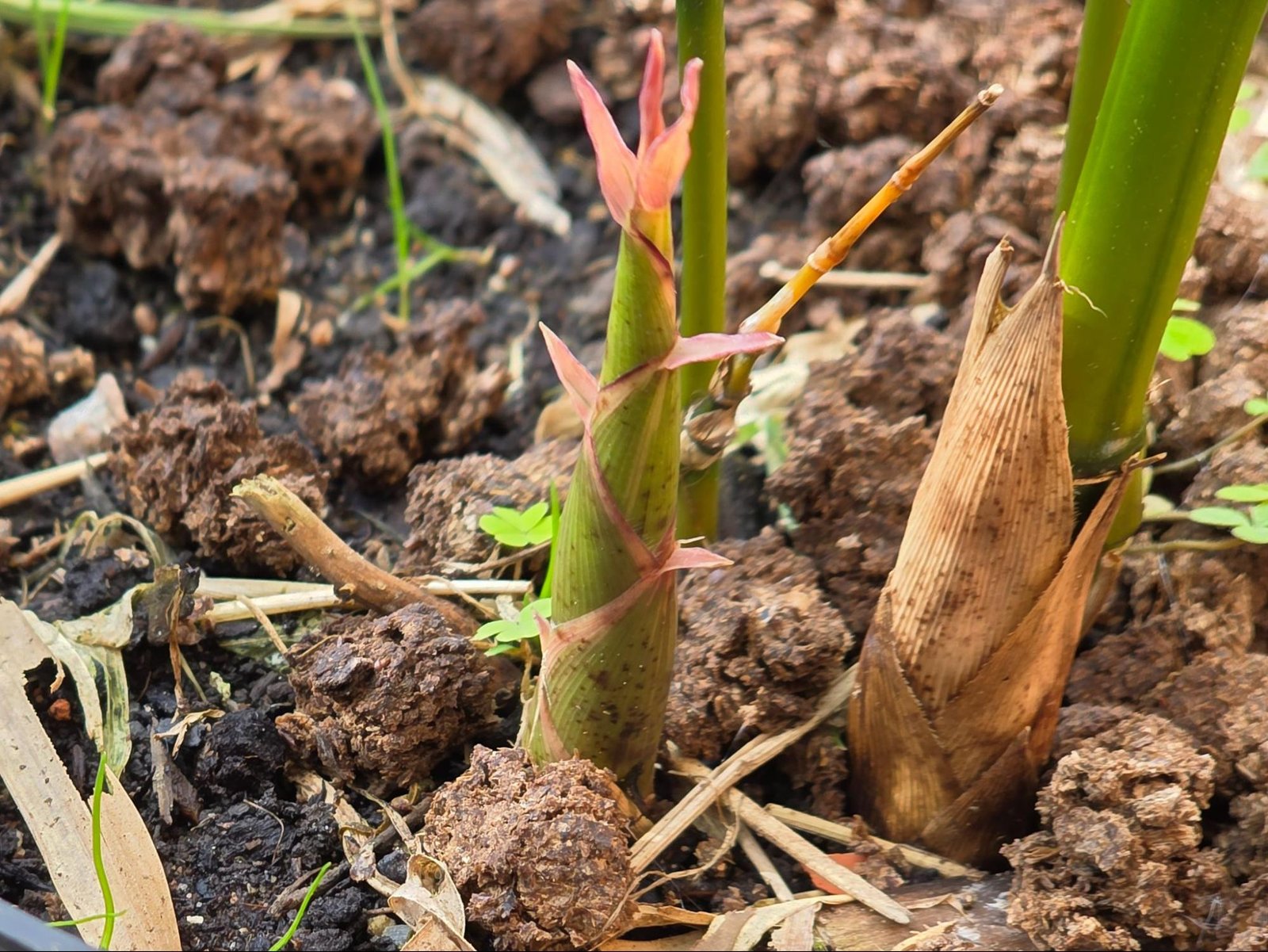 A photo of a small new shoot on Phyllostachys bambusoides ‘Alboveriegata’ taken in the author’s garden, County Durham.
Phyllostachys bambusoides ‘Subvariegata’
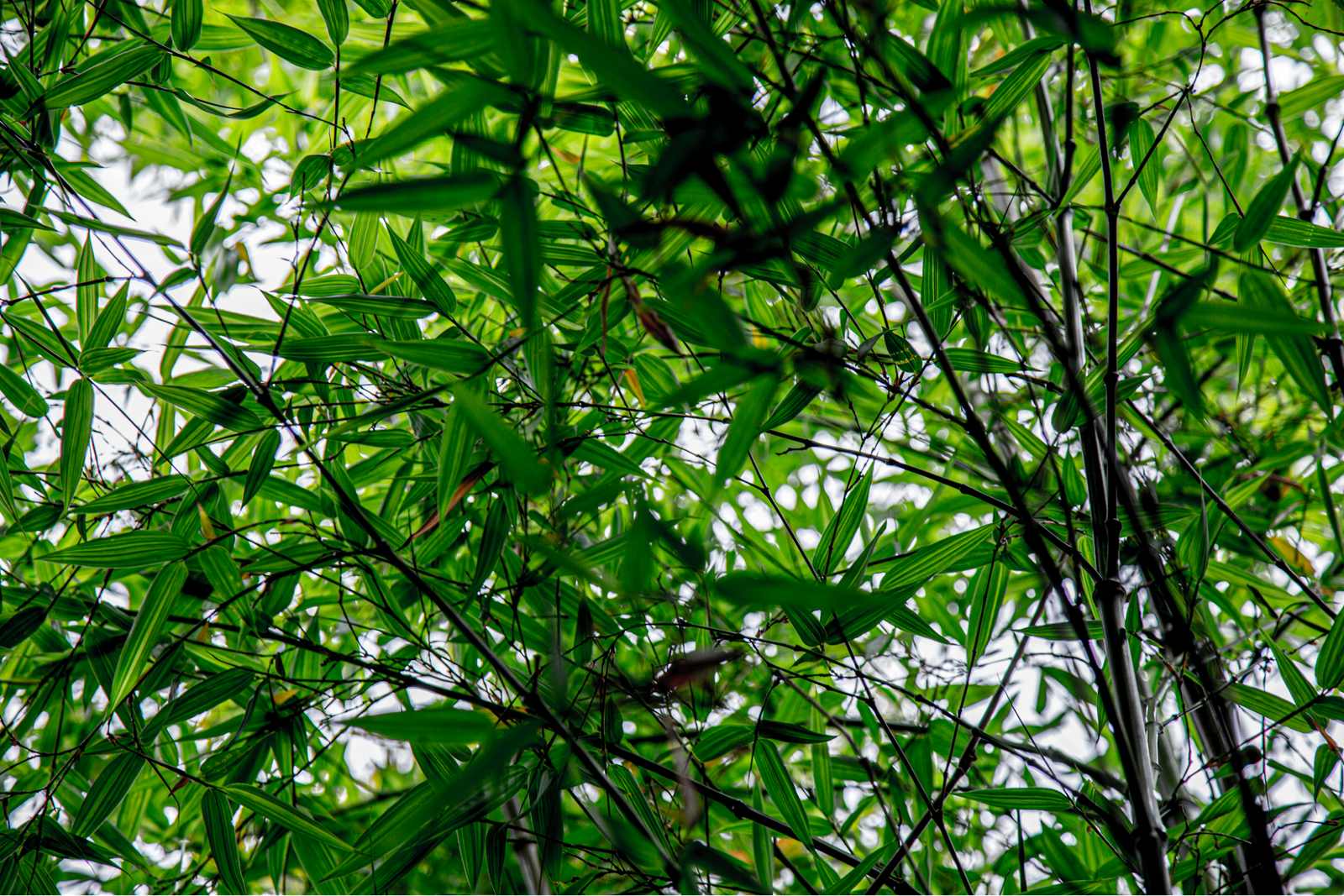 The subtle variegation can be seen in the canopy as the light filters through the leaves. Photograph taken in the collection of Mike Bell. Photograph by James Youdale.
This cultivar differs from the type species by having a subtle striped variegation on leaves. As with ‘Alboveriegata’ it is considered to not grow as strongly as the type species, and, from the horticultural perspective of enjoying this plant’s salient feature, this is not necessarily a drawback. As the above photograph illustrates, it is possible to discern its subtle beauty from underneath the canopy of its foliage, but achieving the requisite understory growing conditions where height can be combined with retaining the variegation most likely requires a woodland setting or a garden that is endowed with the luxury of mature trees.
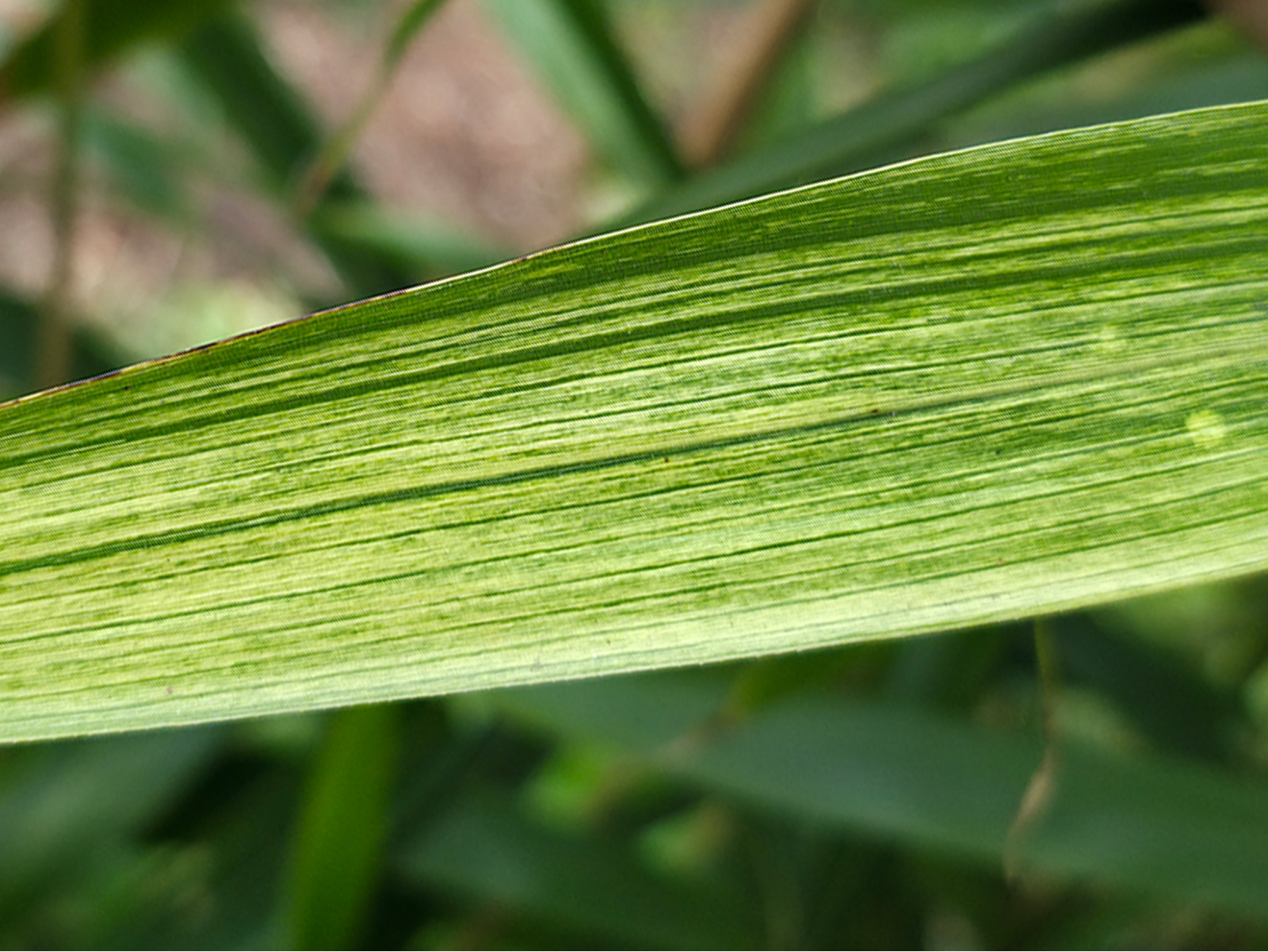 A photograph of a leaf on Phyllostachys bambusoides ‘Subvariegata’ taken by James Youdale in the collection of Peter Markham.
Phyllostachys bambusoides ‘Marliacea’
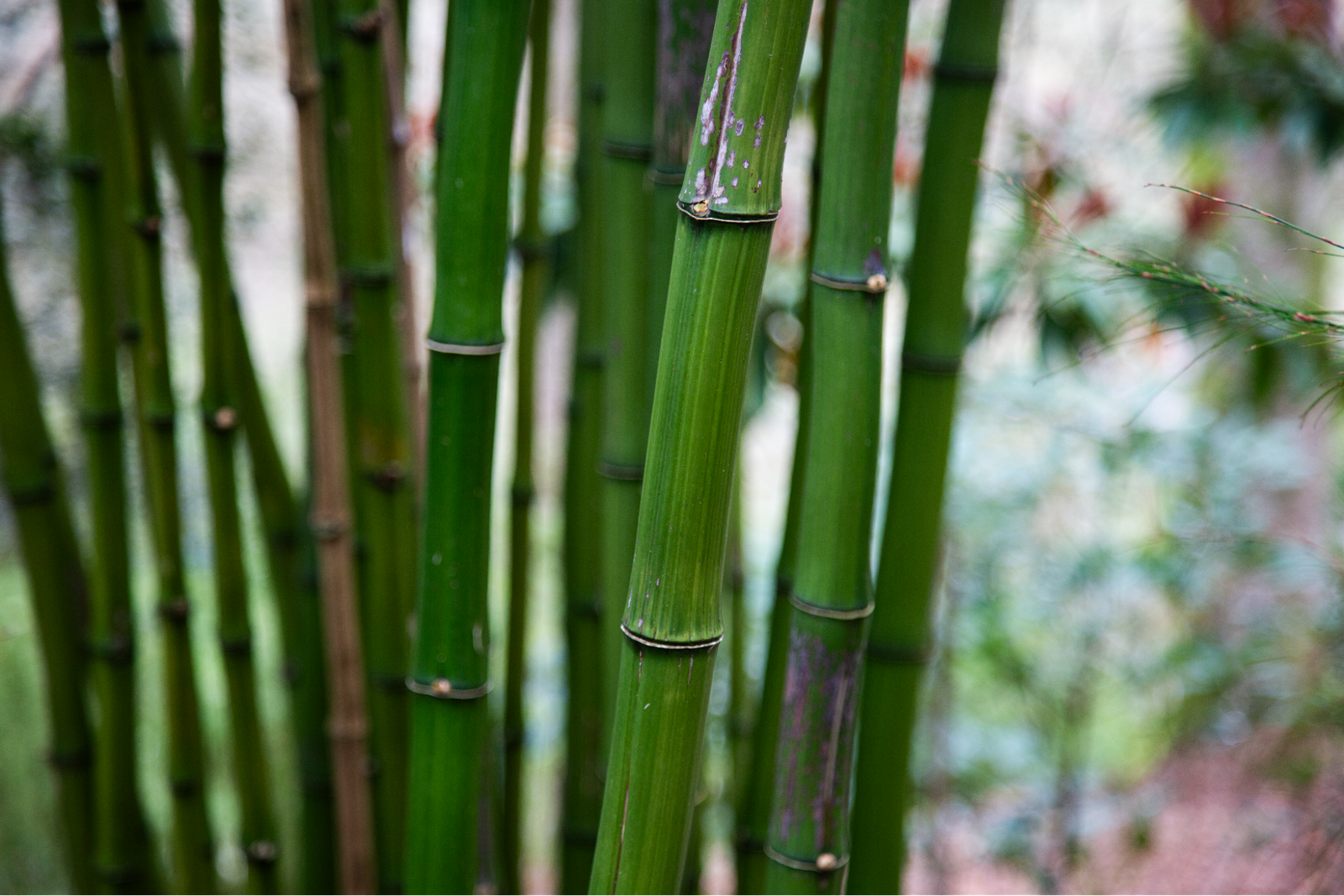 Phyllostachys bambusoides ‘Marliacea’ growing in John Bailey’s Wheal Jenny Garden. Photograph taken by James Youdale.
This cultivar is similar to the type species, but differs in that its green culms appear wrinkled.
Known in Japan as ‘shibo-chiku’ based on the Japanese expression ‘to wither’, Satow’s (1899) translation of Katayama’s Nihon chiku‑fu discusses a fragile cultivar, that may not persist without care and curation:
“It is a curious bamboo from Awa, that is all. In the time of the former daimiōs there were some [plants of ‘Marliacea’] at Sumoto in Awaji, of which much care was taken, but they have now all been cut down. Though some remain round the houses of the small gentry (shi-zoku), if attention is not bestowed on them, they will gradually disappear. Let public-spirited persons take them under their protection.” – Katayama, 1899.
As such, this is an especially rare cultivar of Phyllostachys bambusoides and is frequently in demand. In UK growing conditions it is challenging to propagate and especially slow to develop.
There is a similar form in appearance known as ‘katashibo’, but that is not thought to be grown in the United Kingdom.
Phyllostachys bambusoides ‘Kawadana’
This cultivar differs from the type by possessing a subtle vertical yellow striping on culms with variegated leaves (Shi et al, 2021). When exposed to direct sunlight, however, the colour is known to fade (Bell, 2003).
Indeed, paradoxically, to enjoy its defining characteristic of the culm striping it requires a considered planting position in dappled shade (Whittaker, 2005) – conditions that will also slow the growth and development of a plant that thrives most in full sun with warm soil.
There is a degree of contradiction (isn’t there always) as to where the clone of this form in circulation in the UK emerged from. Mike Bell told me that he observed it in a regenerated stand of Phyllostachys bambusoides ‘Castillonis’ that had flowered in the 1960s. Paul Whittaker gives a different account of it being found in a regenerating plant in Devon in 1985.
Whichever of the two dates is correct, Bell noted the curious markings on the culms, and then cross-referenced it with literature that had described this form – or something generally close to it – elsewhere. Indeed, other clones of this form are said to be cultivated in China at the bamboo garden of Anji Bamboo Expo Park in Zhejiang, and variously in Japan (Shi et al, 2021).
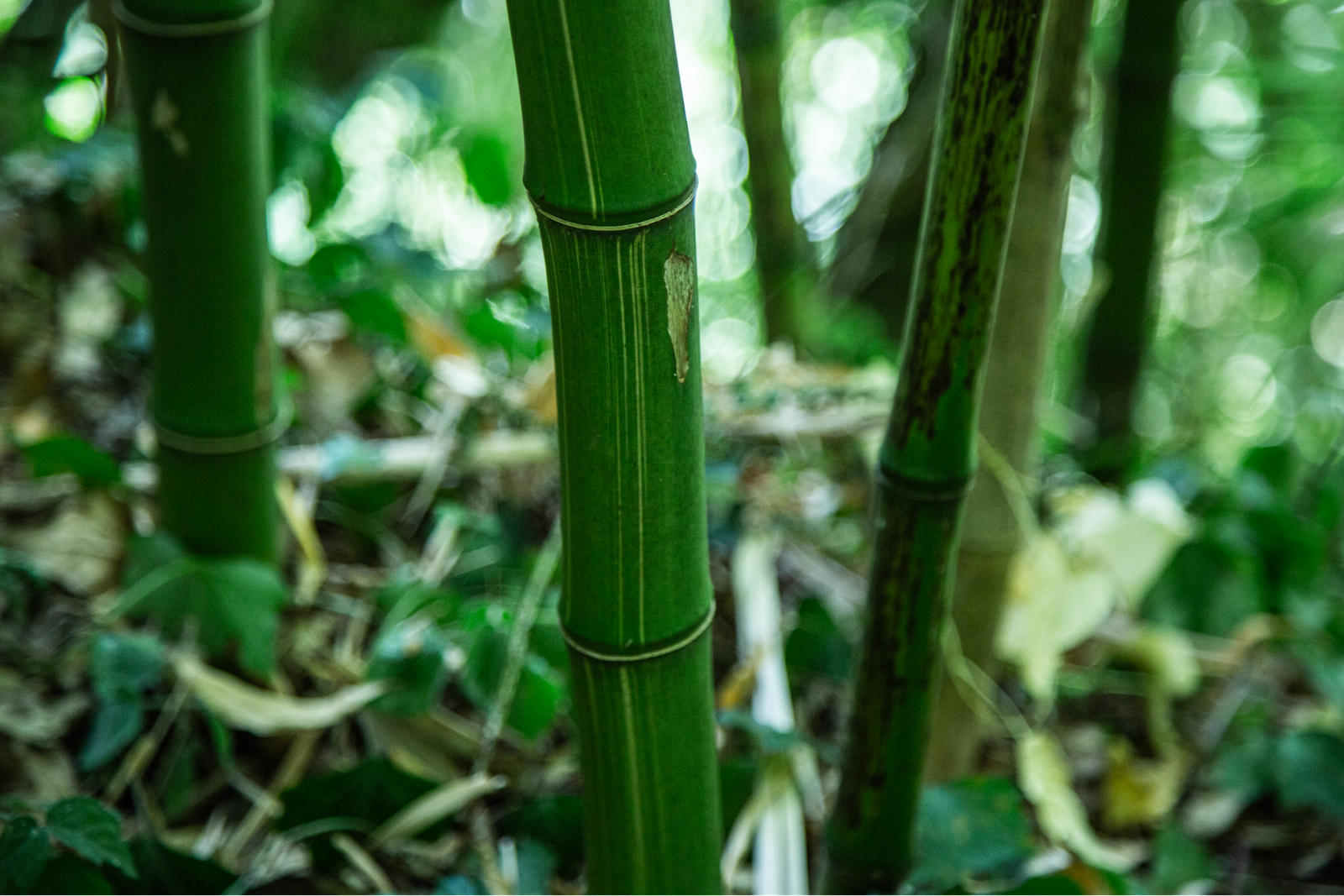 The pattern typical of ‘Kawadana’ is a form of variegation that is not considered to be particularly stable. A similar albeit more subtle pattern can be seen here at the base of a new culm of Phyllostachys dulcis. Photograph taken by James Youdale in John Bailey’s ‘Wheal Jenny’ Garden.
‘Kawadana’ is thought to only achieve a maximum height of 5 meters, and has been observed to behave in a refined, clumping manner in growing conditions in the UK and Germany (Greiner, n.d). Indeed, anecdotally, Mike Bell and others (Mogridge, n.d.) have reported this plant to be a particularly weak growing form of the species. This is a point that Bell notes of Phyllostachys which have regenerated from flowering in his experience. Indeed, as of August 2026, the plant in the National Collection has ceased to be – hence, no reference photograph! A good photograph (I believe taken by Richard Childs) can be found on page 145 of Paul Whittaker’s 2005 book: “Hardy Bamboos: Taming the Dragon”.
As with ‘Marliacea’, this cultivar is considered to be especially challenging to propagate (ibid, n.d) and is incredibly rare in the UK – bordering on being out of cultivation. It is thus generally thought of as being a ‘collectors’ plant.
Phyllostachys bambusoides ‘Tanakae’ and ‘Lacrima-deae’
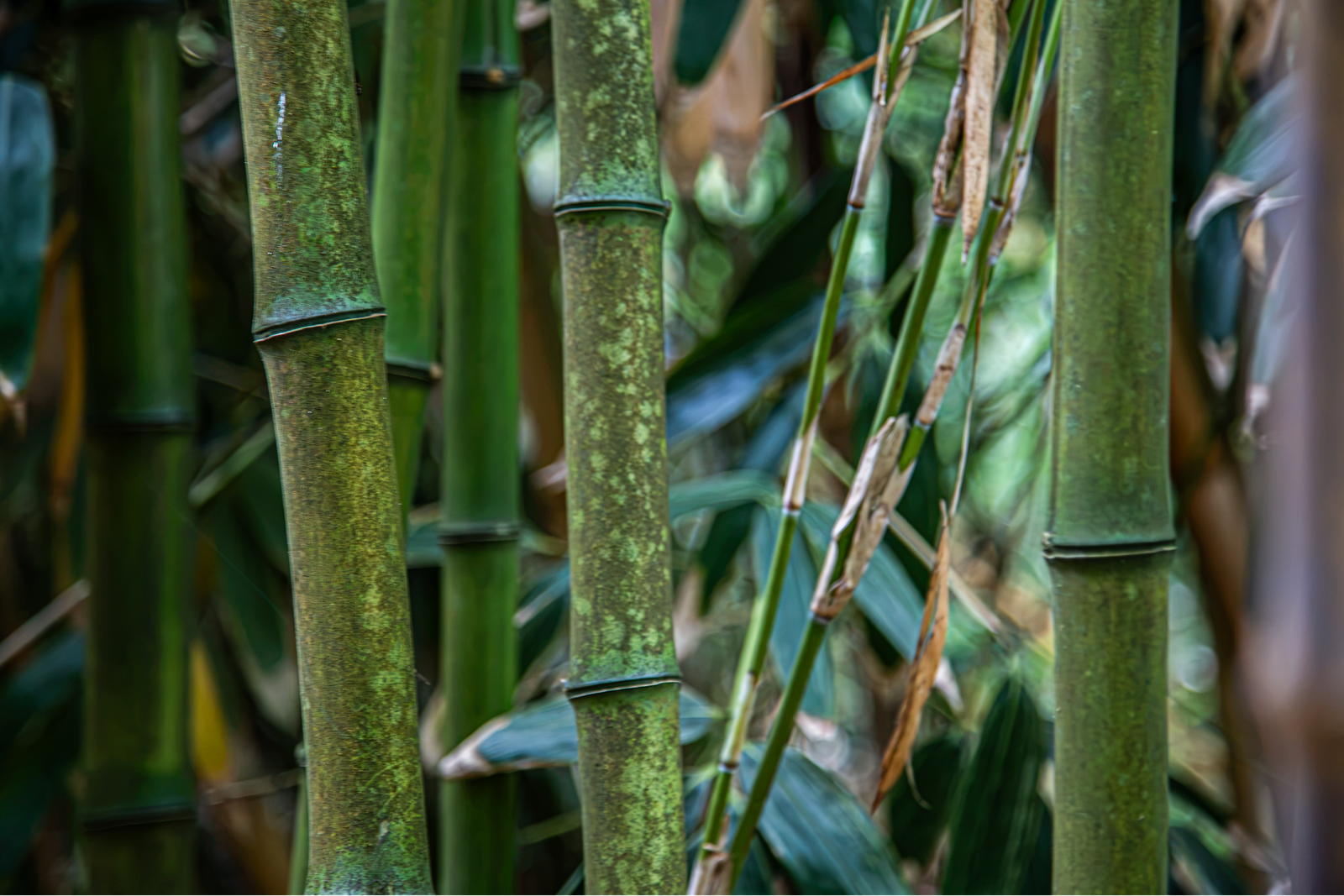 A photograph of Phyllostachys bambusoides ‘Tanakae’ growing in the collection of Mike Bell. ‘A diseased Japanese bamboo’?
This is sometimes referred to as the ‘leopard bamboo’. It differs from the type species by developing dark brown or purple spots on its culms as they age – usually appearing in the second year. It is speculated that this particular feature is caused by a virus or fungal infection, but it appears to usually persist in propagated material from a parent plant that carries the characteristic. This cultivar is very rare in cultivation in the UK.
This cultivar is said to need a very warm summer to develop its emblematic colouration (Van der Palen, n.d. b) and perhaps this limits the extent to which it can be observed in specimens on these shores. Indeed, the plant growing in the National Collection in Cornwall does not really resemble photographs of the plant taken elsewhere in the world. David Crampton’s appraisal of the same plant some twenty years earlier also portrays this.
“[This is] something of a collector’s bamboo that is more interesting than beautiful” (Crampton, 2006, p195)
Crampton further remarked of his own failed attempts to import other specimens from China, and thus suggested that many of the plants sold in cultivation under this name are in fact just the type species of bambusoides, and will never develop its distinctive colouration. One could speculate over whether he was sold a batch of duds by an unscrupulous salesperson, or perhaps local growing conditions or something ensuing from the propagation process prevented the spotting from ever developing.
Indeed, whilst Whittaker (2005) also alluded to a sense of disappointment by UK growers with the clone of this plant most widely known in collections, he did however report that his attempts to import plants from China were much more fruitful, and the coloration was significantly more impressive. Whether said plants were eventually sold more widely to customers and indeed where said plants reside now is unknown.
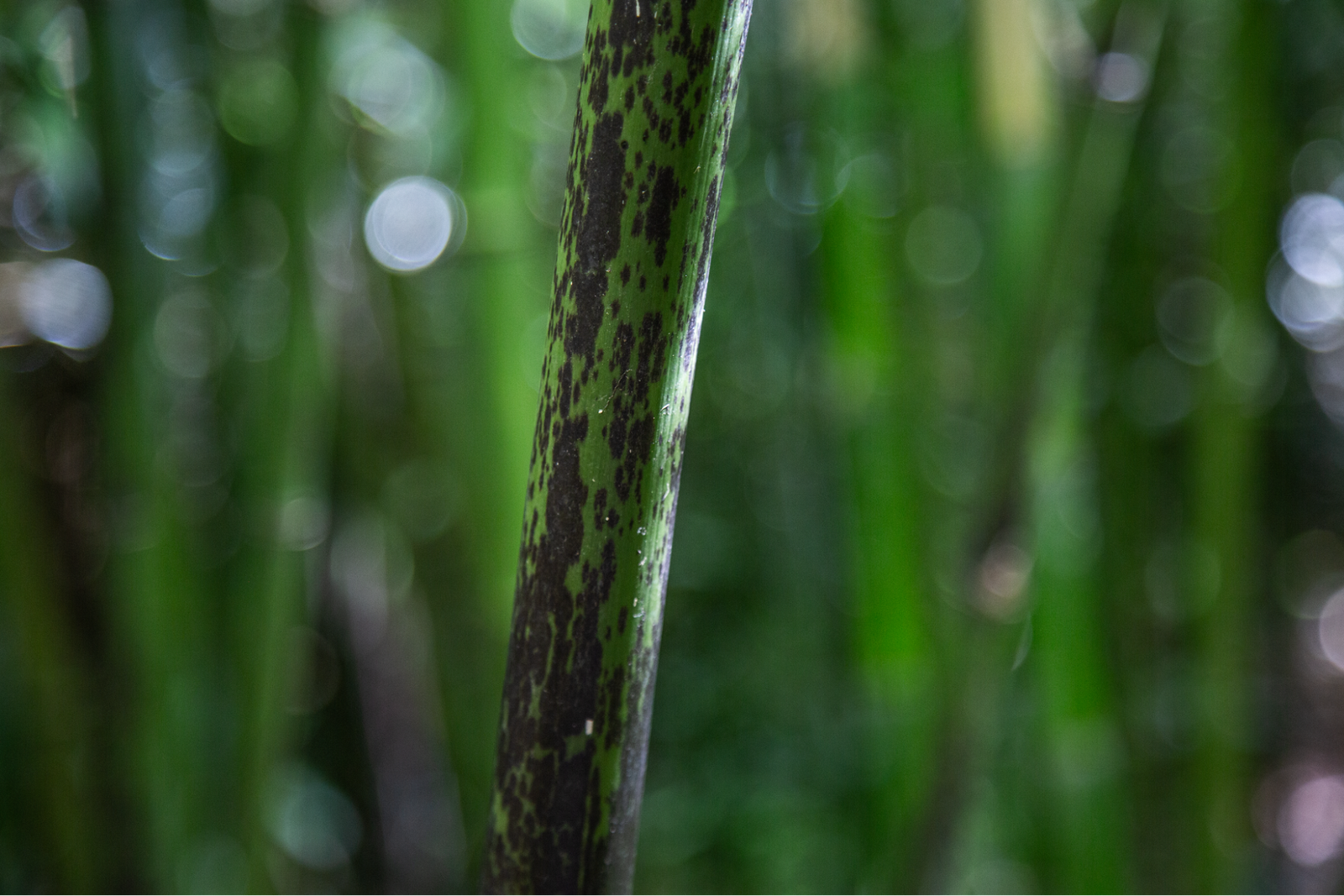 Phyllostachys glauca ‘yunzhu’ is probably a better candidate for those looking for a bamboo with a spotted colouration. Photograph taken by James Youdale in the collection of Mike Bell.
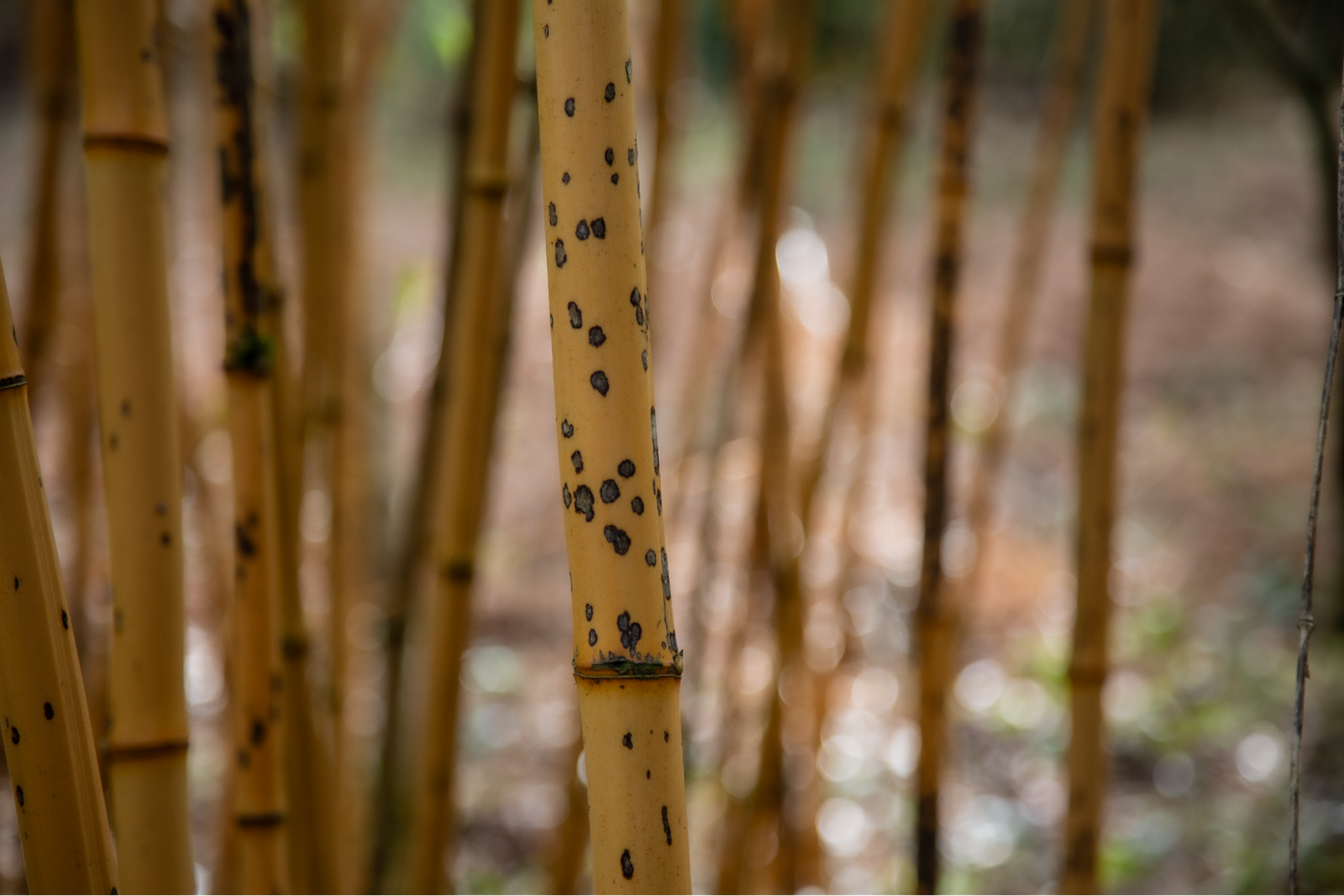 On some occasions, other forms of Phyllostachys bambusoides can develop the spotting typical of ‘Tanakae’. Here, a stand of Phyllostachys bambusoides ‘Holochrysa’ at John Bailey’s Wheal Jenny Garden has developed the appearance. Photograph by James Youdale.
‘Lacrima-deae’
‘Tanakae’ is often considered to be a synonym of ‘Lacrima-deae’ in the west (Whittaker, 2005; Vaupal, 2005d). The latter means ‘tears of the Goddess’, earning its name after the Chinese legend of the moon goddess Chang’e, who, having been imprisoned in heaven and thus kept away from her archer husband, drops her tears onto three sacred bamboos (Alziax, 2021).
It is said that this form occurs in the wild in China in areas between the Huang He river and the Yangtze river (Shi et al, 2021)
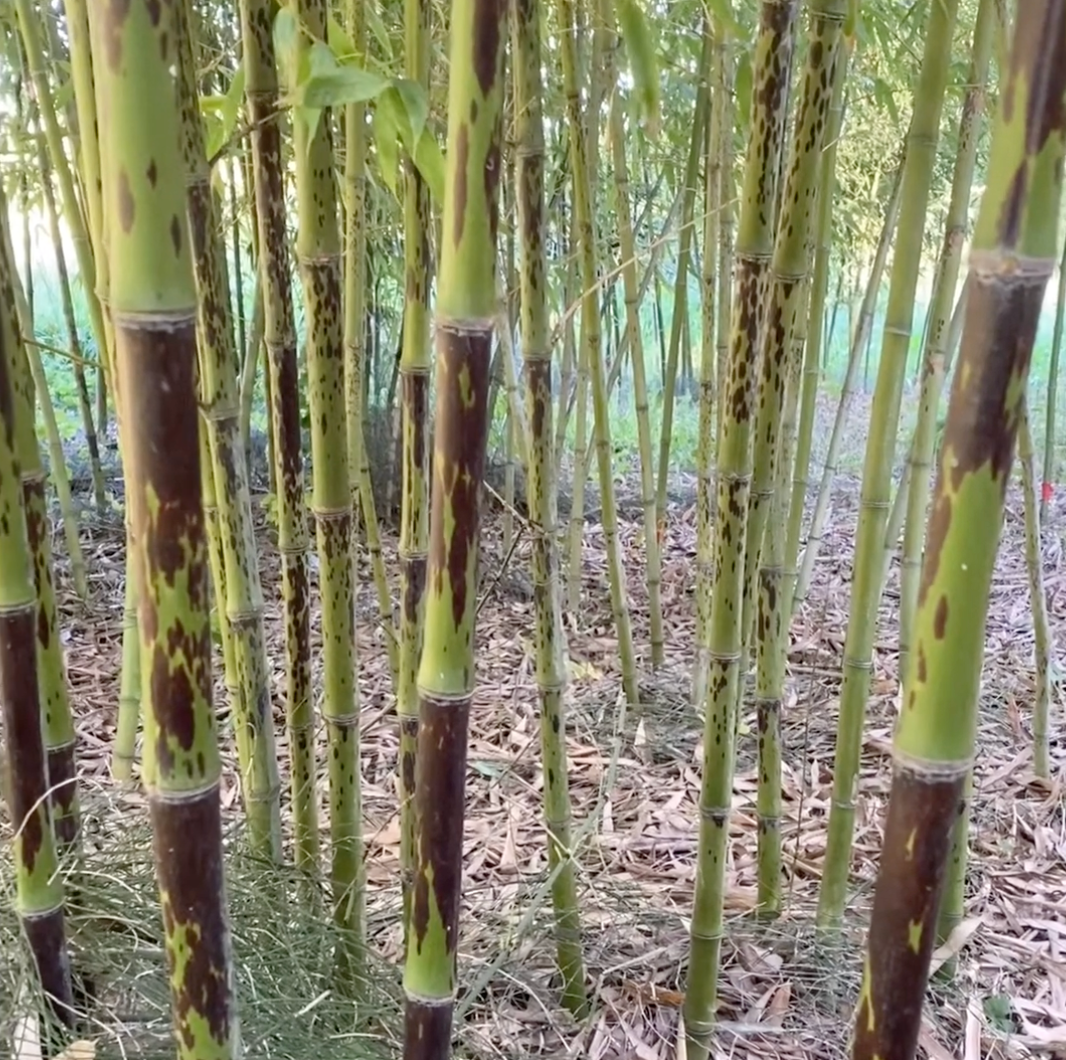 Phyllostachys bambusoides ‘Lacrima-deae’ growing in France. Image captured from a video by Stéphane Alzaix (2021).
While the two cultivars are discussed together here within the context of this article – which focuses on plants available in the United Kingdom – both in literature and the nursery trade they have also been treated separately. One reason given pertains to a different function being speculated as the cause of the distinctive spotting on culms (Alzaix, n.d.b). Stéphane Alzaix provides an interesting anecdote around confusing the two while in China, which is translated from French below:
‘I will remember all my life the response I received in China when I committed the sacrilege of confusing these two [cultivars]. The director of the park where we were staying had the following sentence translated for me: “One must not confuse a diseased Japanese bamboo with a sacred Chinese bamboo!”’ – Alzaix, n.d b
Phyllostachys bambusoides ‘Mixta’
This form appears similar to the ‘Castillonis inversa’ cultivar in that it has green culms with a yellow sulcus groove, but culms also develop the black spots seen in the ‘Tanakae’ / ‘Lacrima-dea’ forms.
It is considered incredibly rare in cultivation in the United Kingdom (if truly in cultivation at all), and is said to be very challenging to propagate (Alzaix, n.d.a).
It would seem that two recent importations of plants into Europe from China have occurred instigated by Stéphane Alzaix in France and Jos van Der Palen in the Netherlands respectively, and thus with the potential for post-Brexit restrictions around buying plants from Europe being lessened in 2028, this raises the prospect of this form being more widely available to UK growers in the near future.
Here’s hoping, at least.
Where to see
- Penjerick Garden (Cornwall) – type species
- The Lost Gardens of Heligan (Cornwall) – Holochrysa and Castillonis inversa
- Durham University Botanic Gardens – Holochrysa
Where to acquire in the United Kingdom
- Whitelea Nurseries – ‘Holochrysa, ‘Castillonis’ and ‘Castillonis inversa’ forms.
- The Rodings Plantery – Type species, ‘Kawadana’, ‘Alboveriegata’, ‘Subvariegata’, ‘Marliacea’
References
Alziax, S. (n.d.a) Phyllostachys bambusoides ‘Mixta’. Newfi Shop. Available at: https://www.newfishop.fr/phyllostachys-bambusoides-mixta/ (Accessed: 18 August 2026).
Alziax, S. (n.d.b) Phyllostachys bambusoides ‘Lacrima-deae’. Newfi Shop. Available at: https://www.newfishop.fr/phyllostachys-bambusoides-lacrima-deae/ (Accessed: 18 August 2026).
Alziax, S. (2021) Les bambous tachetés [Video]. YouTube. Available at: https://www.youtube.com/watch?v=bdJiglL2Sqo (Accessed: 18 August 2026). [youtube.com]
Bell, M. (2003) The gardener’s guide to growing temperate bamboos. London: Timber Press.
Crompton, D.W.T. (2006) Ornamental bamboos. Portland, OR: Timber Press.
Katayama, N., 1899. Nihon chiku‑fu (The Cultivation of Bamboos in Japan).
Translated by E.M. Satow. Transactions of the Asiatic Society of Japan, 27(3), pp. 1–127.
Mitford, F. (1896) The Bamboo Garden. London: Macmillan and Co.
Recht, C. and Wetterwald, M.F. (1992) Bamboos. Portland, OR: Timber Press.
Shi, J.Y., Zhang, Y.X., Zhou, D.Q., Ma, L.S. and Yao, J. (2021) Illustrated Flora of Bambusoideae in China. Volume 1. Singapore: Springer.
Vaupel, F. (2005a) Phyllostachys bambusoides. Available at: https://www.bambus-lexikon.de/phyllostachys-bambusoides0.html (Accessed: 1 July 2026).
Vaupel, F. (2005b) Bambusoides castilloni inversa. Available at: https://www.bambus-lexikon.de/bambusoides-castilloni-inversa0.html (Accessed: 1 July 2026).
Vaupel, F. (2005c) Bambusoides holochrysa. Available at: https://www.bambus-lexikon.de/bambusoides-holochrysa0.html (Accessed: 1 July 2026).
Van der Palen, J. (n.d. a) Bamboo Catalog. Kimmei Bamboo Nursery. Available at: https://www.kimmei.com/ecatalogus.html (Accessed: 3 July 2026). [kimmei.com]
Van der Palen, M. (n.d. b) ENI Nieuws. Available at: http://www.kimmei.com/enieuws.html (Accessed: 6 July 2026).
Wilson, D. (2025) Phyllostachys bambusoides ‘Castillonis’. UK Bamboos. Available at: https://uk-bamboos.co.uk/Detail-B/phyllostachys_bambusoides_’Castillonis’.htm (Accessed: 18 August 2026).
Whittaker, P. (2005) Hardy Bamboos: Taming the Dragon. Portland, OR: Timber Press.
Whittaker, P. (2010). Practical Bamboos: The 50 Best Plants for Screens, Containers and Gardens. Timber Press.